Funding the Forest's Future
Two organizations in Jefferson County invested in forest health. Here's how it paid off.
SUMMARY
Jefferson Conservation District implemented wildfire risk reduction treatments in areas of Jefferson County, Colorado, and saw first hand how those treatments helped prevent a wildfire from being catastrophic.
Neighboring public land manager Jefferson County Parks & Open Space is doing the same thing on their public lands, knowing that the cost of doing nothing is greater than the cost of proactive forest treatments.
The Scene
Meet Jefferson Conservation District
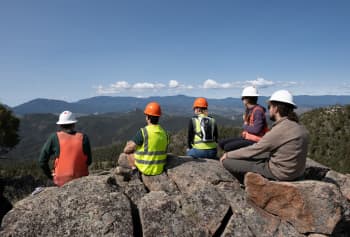
Jefferson Conservation District (JCD) partners with private landowners in and around Jefferson County, CO to implement conservation projects, primarily on private property. These projects typically have the shared stewardship goals of ecological restoration coupled with wildfire mitigation. In their area, that typically means returning our forests to a more open and variable condition, which historically occurred by frequent fire; restoring the openness prepares the land to receive fire in a safer and beneficial manner.
As part of holistic forest restoration, JCD staff assist private landowners with planning and implementing forest and noxious weed management projects on their land to restore ecosystems and mitigate wildfire hazards. In partnership with Jefferson County, JCD also delivers the annual Slash Collection Program(opens in new window) for residents working on their own defensible space and home hardening.
Meet Jefferson County Parks & Open Space
Jefferson County Parks & Open Space contributes to city and park district projects, has preserved more than 58,000 acres, and manages 27 open space parks, and 275+ miles of trails in Jefferson County, Colorado.
The Natural Resources team at Jefferson County Parks & Open Space plans and implements a range of forest management projects to improve forest health, reduce wildfire risk, enhance wildlife habitat, and maintain aesthetic and ecological values in forested parks.
Management actions are initially based on forest inventories and surveys, during which forest conditions are comprehensively assessed and both goals and objectives for the project are defined. Management actions are then refined through consultation with stakeholders, state and federal agencies, and technical specialists. Implementation often involves a combination of Natural Resources staff, private-sector contractors, and researchers assisting with long-term monitoring and evaluation.
The Challenges
Why Colorado Forests Need Help
By Jefferson Conservation District
"We want a lot from our forests—clean air, clean water, wildlife habitat, recreation opportunities, and a safe place to live. There are also things we don't like about the forest, such as insects and disease, wildfire, and floods. However, those things we don’t like have always been an integral part of the functioning forest ecosystem; without them, we can’t get the things we want from the forest.
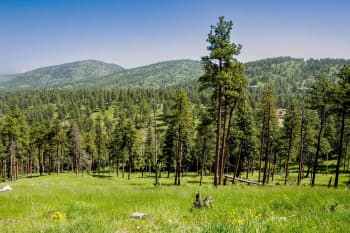
Prior to the last 100 years of fire suppression, natural wildfire in low-elevation forests used to be frequent and less intense; those fires cycled nutrients into the soil, created diverse wildlife habitat, maintained ponderosa pine and aspen forest types, and prevented wildfire fuel from building up too much. In the absence of natural wildfire, forests have become very dense and lost their diversity, and fires today are so intense and large that they endanger communities and ecosystems.
What can we do about this problem? That’s where forest restoration comes in. Supported by an abundance of forest and fire science, we can use forest management techniques to recreate a more diverse and open forest that can thrive with wildfire like it once did."
~ Jefferson Conservation District
The Solutions
When Wildfire Risk Reduction Pays Off
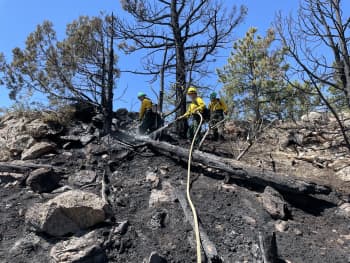
White Hawk Fire Containment Attributed to Previous Mitigation
Matt McLemore, Forest Program Manager, Jefferson Conservation District
Matt McLemore, Forest Program Manager, Jefferson Conservation District
"These types of projects, they can be pretty shocking, both for the public as they see them around the Front Range, but also for the landowners that we work with, it's a big change. But we're trying to get these forests back into a condition that they were historically when they were ready to receive fire on the landscape in a low to medium intensity form. Then wildfire is easier to manage and control for firefighters, and that what happened in the case of the White Hawk Fire."
~Matt McLemore
This is an area near Conifer, Colorado, called Pine Country Lane.
This was the forest before wildfire mitigation by Jefferson Conservation District. It's overgrown and has a high fuel load on the ground.
This is the same area immediately after wildfire mitigation.
Some are taken aback by treatments like this. They might think it looks wrong.
It's true that we are used to seeing the forests in dense conditions across the state. But those conditions are due to human suppression of natural fires over the decades, and we are left with unhealthy forests that are not in a good state to receive fire.
Just one year later, the area has undergone a natural recovery process as old as time.
The forest is thriving and green again. In situations where fire has a lot of ground fuel and burns extremely hot, the forest floor takes a long time to recover (Example: the Hayman Fire, 2002).
When data-based decisions are made for forest treatments they not only help reduce the risk of catastrophic fire, they also allow the forest to recover quickly to a healthy state.
White Hawk Fire
July 22, 2025
Ten years after forest treatments from
Jefferson Conservation District
All photos courtesy of: Jefferson County Sheriff's Office and Elk Creek Fire Protection District
All photos courtesy of: Jefferson County Sheriff's Office and Elk Creek Fire Protection District
AFTERBURN
This photo shows the White Hawk Fire burn area. Many live trees are left standing and the fire did not ruin everything as the fuels had already been reduced. In the background, more treatment areas can be seen.
The Goals of Wildfire Mitigation . . .
. . . and the important side benefit
Matt McLemore, Forest Program Manager, Jefferson Conservation District
Matt McLemore, Forest Program Manager, Jefferson Conservation District
"These projects typically have the shared stewardship goals of ecological restoration coupled with wildfire mitigation. In our area that typically means returning our forests to the pre-settlement era conditions that were maintained by frequent fire, and preparing the lands to receive fire."
~Matt McLemore
This is Beaver Ranch Park near Conifer, Colorado.
Jefferson County Parks & Open Space treated approximately 73 acres of mixed conifer forests at Beaver Ranch Park from July through October of 2025. The goals of this project included reducing the risk of catastrophic wildfire, promoting forest health, and protecting valuable water resources.
This photo shows conditions before treatment.
Immediately after wildfire mitigation.
Before
After
When Mitigation Projects Benefit Both Forest Health Goals and Watershed Resiliency
Valuable impact, on a greater area = more funding.
Tony Auciello, Vegetation Stewardship Supervisor, Jefferson County Parks & Open Space
Tony Auciello, Vegetation Stewardship Supervisor, Jefferson County Parks & Open Space
"We bring County leaders out to our projects and show them what we are doing; we can show them a living before and after picture. We show an area that hasn't been treated, and an area that has been treated. Bringing the decision makers into those areas and letting them visualize what the fire intensity would have been before treatment, really helps them understand why we do the treatments and why that amount of reduction in fuels is so important to protect our landscape."
~Tony Auciello
The Funding
Getting Creative with Funding for Wildfire Risk Reduction and Watershed Resiliency
Often, it take multiple sources.
Forest treatments for wildfire risk reduction and watershed resiliency can get expensive. Jefferson Conservation District gets creative and sources funding from multiple outlets. In the case of the Pine Country Lane project, they used funding from the Natural Resources Conservation Service (NRCS), Denver Water, the state, as well as landowner contributions. All of this together helped pay for the important work on the ground.
Jefferson County Parks & Open Space has utilized the Forests to Faucets program as a funding source for their projects. Forests to Faucets utilizes both federal and private money and is primarily supported by Denver Water, with other partners. This program focuses on strategic landscape projects that will help protect downstream water sources. The return on investment for those types of projects cannot be understated. Denver Water has conducted studies showing ROI ranging from two to five times in various cases.
The Support of County Leadership Matters
Tony Auciello, Vegetation Stewardship Supervisor, Jefferson County Parks & Open Space
Tony Auciello, Vegetation Stewardship Supervisor, Jefferson County Parks & Open Space
Hot Take
The ROI Tells Why
Stories like these from Jefferson County prove that proactive mitigation provides a return on investment (ROI) through avoided response and recovery costs. Research has shown that forest and watershed treatments return up to $7 for every $1 invested. When considering the broader economic and workforce impacts of resilience investments, total benefits can be significantly higher, up to $13 per $1 invested.
Sources:
Return on investments in restoration and fuel treatments in frequent-fire forests of the American west: A meta-analysis. (Hjerpe, et al., 2024).
The Preparedness Payoff: The Economic Benefits of Investing in Climate Resilience (U.S. Chamber of Commerce, Allstate, and the U.S. Chamber of Commerce Foundation, 2024)
The Wildfire and Watershed Initiative for Resilient Colorado (WWIRC) advances statewide sustainable public-private funding and other strategies to enhance the pace and scale of catastrophic wildfire risk reduction and watershed resilience.
Learn more about WWIRC
Special thanks to:
Matt McLemore, Forest Program Manager, Jefferson Conservation District
Tony Auciello, Vegetation Stewardship Supervisor, Jefferson County Parks & Open Space
 Built with Shorthand